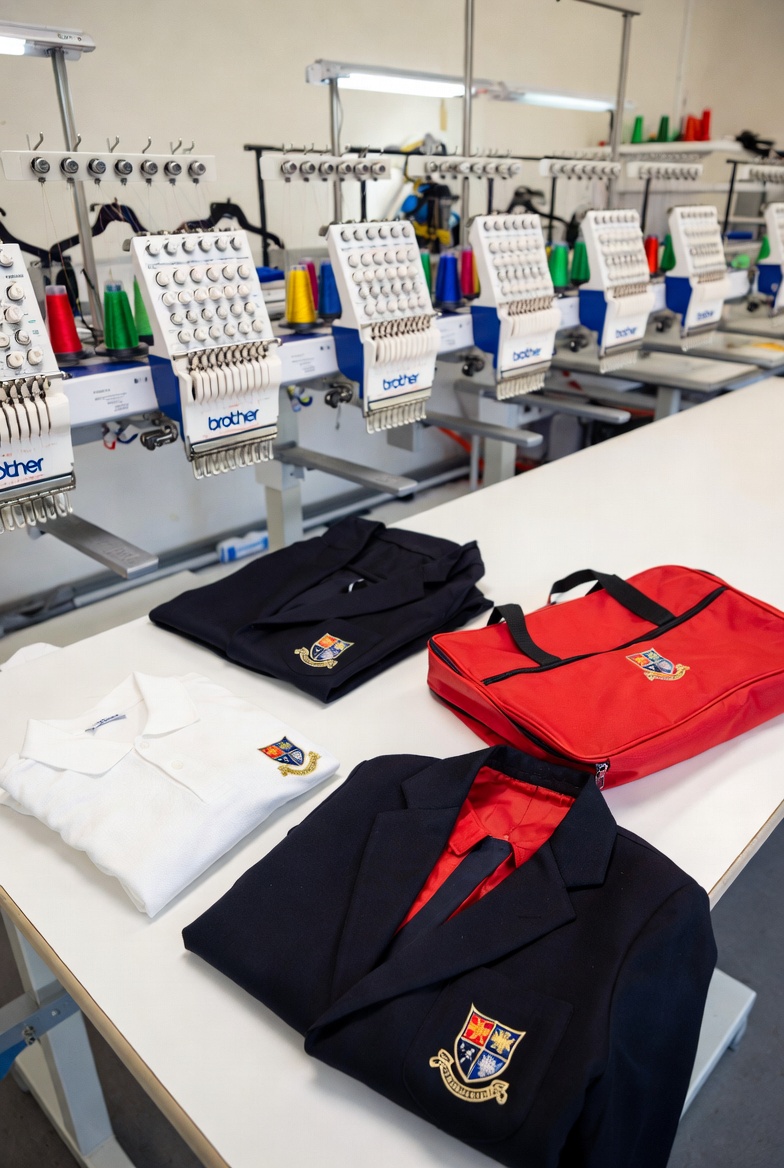
The School Uniform Challenge
Prestige School Uniforms supplies embroidered school uniform items — blazers, polo shirts, PE kits, and book bags — to 165 primary and secondary schools across Nottinghamshire, Derbyshire, and Leicestershire. The business operates from a production unit in Nottingham with a team of twelve, including four embroidery machine operators running six Brother PR680W multi-needle machines. Annual revenue exceeds £800,000, with the majority generated during the intense May-August back-to-school season.
Every school in Prestige's portfolio has a unique badge or crest. Some are simple designs — a shield shape with the school name in a standard font. Others are complex heraldic-style crests incorporating motifs, mottoes in Latin, multiple colour regions, and fine detail that tests the limits of embroidery thread resolution. The diversity is enormous: 165 schools means 165 completely different stitch files, plus variants for different garment types (the badge placement and size differs between a blazer breast pocket, a polo shirt chest position, and a PE kit bag panel).
Managing this library of stitch files has always been the operational backbone of the business. New schools are added to the portfolio annually, existing schools occasionally update their badges, and every badge needs to be maintained in multiple size and format variants. The stitch file library represents thousands of hours of accumulated digitizing work and is arguably the most valuable intangible asset the business owns.
The Annual Re-Digitizing Burden
In 2024, Prestige faced a significant operational challenge. Their embroidery machines were upgraded from older single-head units to the new Brother PR680W multi-needle machines, which offered higher production speeds and better stitch quality but used a different stitch format (PES) than the DST files that had been generated for the previous machines. Additionally, many of the older stitch files had been digitized years earlier to lower quality standards — poor pull compensation, inefficient pathing, and colour sequences that did not match current Madeira thread stocks.
The decision was made to re-digitize the entire catalogue — all 165 school badges in all their variants — to take full advantage of the new machines' capabilities. Using their existing outsourced digitizing service at £25 per badge, the estimated cost was £4,125 for the base badges alone, plus additional costs for size variants. The estimated turnaround, at the bureau's normal processing rate of approximately 12 badges per week, was 13-14 weeks. Given that the re-digitizing needed to be complete before the May production ramp-up, this timeline was uncomfortably tight.
StitchFast and the One-Week Sprint
Prestige's operations director, James Morton, had been evaluating StitchFast for several months when the re-digitizing project crystallised the urgency. He proposed running the entire catalogue through StitchFast as both a cost-saving measure and a proof of concept for the platform's quality at scale. The management team agreed to a trial: 30 badges through StitchFast first, with a quality assessment before committing the remainder.
The trial batch of 30 badges was processed in a single afternoon. James uploaded each school's badge artwork (clean PNG files extracted from the company's design archive), downloaded the PES files, and queued them for test stitching the following morning. The machine operators ran all 30 badges on the new Brother PR680W machines using production garments and standard backing. Twenty-eight of the thirty were immediately approved for production. The two requiring adjustment needed minor density changes for very small text elements — a five-minute fix each in the Brother editing software.
With the trial confirming acceptable quality, James processed the remaining 135 badges over the following four days. The total elapsed time for digitizing 165 school badges, including uploading, downloading, organising into the production file library, and generating size variants, was approximately 35 hours of staff time spread across one week. The previous estimate for outsourced digitizing was 13-14 weeks and £4,125. StitchFast delivered the same output in one week at a cost of £29.99.
Production Season Impact
The speed of the re-digitizing sprint had a dramatic downstream effect on Prestige's 2025 back-to-school season. With all 165 badges production-ready three months earlier than the outsourced timeline would have allowed, Prestige was able to begin production in late February rather than May. This early start meant that when the tsunami of parent orders arrived in June and July, Prestige was already three weeks ahead of their normal production schedule.
The early production advantage manifested in several ways. Dispatch times during peak season averaged 5 working days compared to the previous year's 12 working days. Customer complaints about late delivery dropped by 78 percent. Schools received their initial stock allocations before the end of the summer term rather than during the first week of the new term, allowing school offices to distribute uniforms before the holiday break. Parent satisfaction, as measured by post-purchase survey responses forwarded by partner schools, reached the highest levels in Prestige's history.
The quality of the new StitchFast-generated files contributed to production efficiency gains as well. Thread breaks per 1,000 garments dropped from 34 to 18 — a 47 percent reduction attributable to cleaner stitch pathing and more efficient colour change sequences. Machine operators reported that the new files ran more smoothly than the old manually digitized files, with less frequent interventions required during multi-head production runs.
Ongoing Operations
Prestige now uses StitchFast as their standard digitizing platform for all new school onboarding and badge updates. When a new school joins the portfolio, their badge is digitized through StitchFast on the same day the artwork is received — a process that previously took up to a week through the external bureau. When an existing school updates their badge design (which happens 8-12 times per year across the portfolio), the new version is digitized and ready for production within hours.
The annual cost comparison is stark. Previous annual digitizing spend for new schools, updates, and variant generation: approximately £5,500. Current annual spend: £360 (StitchFast Unlimited). Net saving: over £5,100 per year, representing an 89 percent cost reduction. The saving is redirected into production equipment and staff training, further improving the quality and capacity of Prestige's embroidery operation.
Grey bars show the figure before StitchFast; green bars show after.
Advice for School Uniform Suppliers
James Morton's advice to other school uniform suppliers is direct: the economics of outsourced digitizing do not make sense when every school has a unique badge and badge variants multiply the file count. A supplier serving 100 or more schools will spend thousands annually on digitizing fees that add no value to the finished product. StitchFast eliminates this cost entirely and removes the turnaround constraint that bottlenecks production scheduling during the busiest period of the year.
For suppliers considering a catalogue re-digitizing project similar to Prestige's, James emphasises the importance of clean source artwork. The quality of StitchFast's output is directly proportional to the quality of the input image. Schools with vector-format badge artwork (SVG or AI files) produce the best results. Schools with only low-resolution JPEG logos from their website may require the artwork to be cleaned up before uploading. Prestige invested approximately 40 hours of graphic design time cleaning up artwork for schools with poor-quality source files, but this was a one-time effort that improved the production quality of every future order for those schools.
Badge Complexity Across the School Portfolio
The 165 schools in Prestige's portfolio represent an extraordinarily diverse range of badge complexity. At the simpler end, primary school badges tend to be circular or shield-shaped designs with the school name in a clear font, a simple motif (a tree, a star, a book), and two or three colours. These badges typically measure 60-70mm in diameter and contain 8,000-12,000 stitches. StitchFast handles these effortlessly, producing clean files that stitch perfectly on every garment type.
At the complex end, grammar school and academy crests can be extraordinarily detailed — heraldic shields with quartered fields, Latin mottoes in ornate script fonts, multiple animal or botanical motifs, and crown or mitre details that require precise stitch direction to render convincingly at embroidery scale. These badges may contain 25,000-35,000 stitches across eight or more colour changes, and the dimensional precision required is exacting because parents compare the embroidered badge to the school's printed version and expect an exact match.
StitchFast's performance across this complexity spectrum was remarkably consistent during the catalogue re-digitizing sprint. Simple badges were processed without any issue. Complex heraldic crests were processed with occasional minor adjustments — typically to the density of very fine text elements in Latin mottoes, where the physical resolution of embroidery thread limits how small text can be rendered legibly. James estimates that the average time spent on post-generation adjustments across all 165 badges was approximately 90 seconds per badge — a trivial investment compared to the hours that a human digitizer would spend on the same work.
Parent and School Feedback
The improvement in badge quality has been noticed by both schools and parents. Several school administrators have commented that the current year's embroidered badges are "sharper" and "more consistent" than previous years' versions — feedback that aligns with the objective quality measurements showing reduced thread breaks, more consistent fill density, and better colour accuracy in the StitchFast-generated files. Parents, while not explicitly aware of the change in digitizing method, have generated fewer complaints about badge quality and appearance in post-purchase surveys.
One particularly gratifying piece of feedback came from a secondary school whose complex heraldic crest had been a persistent source of quality complaints under the previous digitizing method. The human digitizer had struggled with the crest's fine detail — a scroll banner containing the school motto in 4mm text, with thin hairline borders separating quartered shield sections. Previous versions showed visible inconsistency in the hairline borders and occasional illegibility in the motto text. The StitchFast version, after a minor density adjustment to the motto text, produced a cleaner, more precise result that the school's headteacher described as the best embroidered version of their crest they had ever received.
Inventory Management and Pre-Season Production
The three-week advance in production timing enabled by StitchFast had significant implications for Prestige's inventory management strategy. School uniform demand is highly predictable in aggregate but uncertain at the individual item level — a parent might order two polo shirts or five, and the split between sizes varies from school to school based on the age demographics of the student body. Managing this uncertainty requires either holding significant finished-goods inventory (expensive and risky if demand patterns shift) or maintaining the ability to produce to order rapidly (dependent on production capacity and speed).
The three-week production advance allowed Prestige to build strategic buffer stock for their twenty highest-volume schools before the peak ordering period began. This buffer stock — approximately 40 percent of each school's expected total demand in the most popular sizes and garment types — was produced during the relatively quiet March-April period when machine capacity was abundant. When the parent ordering surge arrived in June-July, these buffer garments shipped immediately while fresh production covered the remainder. The result was a measurable improvement in dispatch speed precisely when speed matters most.
Prestige estimates that the combination of pre-built buffer stock and faster in-season production reduced their peak-season staffing requirement by one full-time temporary worker (a saving of approximately £3,500 for the season), while simultaneously improving delivery performance. The ROI of StitchFast adoption — considering both the direct digitizing cost saving and the indirect operational efficiency gains — exceeds 15x the annual subscription cost.
Multi-Format Generation for Different Machine Types
Prestige School Uniforms operates six Brother PR680W machines, all using PES format stitch files. However, the business also subcontracts overflow production during peak season to a partner company that operates Tajima machines requiring DST format. Previously, this meant maintaining two separate versions of every badge file — a PES version for in-house production and a DST version for the subcontractor. Each format conversion introduced a small risk of parameter changes, and maintaining two file libraries doubled the administrative burden.
StitchFast simplified this by allowing Prestige to generate both PES and DST versions of every badge directly from the same source artwork. James generates both formats during the initial digitizing process, stores them in clearly labelled directories, and sends the appropriate format to whichever production facility will handle each order. The files are generated from the same AI analysis of the same source image, ensuring identical stitch content regardless of output format. This eliminated the conversion step and its associated risks.
The multi-format capability also future-proofs Prestige's file library against potential machine upgrades. If the business ever transitions to different machine brands — perhaps adding Barudan or Tajima units to increase capacity — the file library does not need to be re-digitized. James simply uploads the source artwork to StitchFast and generates files in whatever format the new machines require. This flexibility reduces the switching cost of capital equipment decisions, which in turn gives Prestige more negotiating leverage when purchasing or leasing new machines.
Building the Digital Badge Archive
An unexpected benefit of the StitchFast re-digitizing project was the creation of a comprehensive digital badge archive. Previously, Prestige's badge files were scattered across multiple hard drives, USB sticks, and email inboxes — accumulated over years of outsourced digitizing from multiple suppliers. Some older files had been lost to hard drive failures or email purges. The re-digitizing sprint forced James to locate or recreate clean source artwork for every school, and the resulting archive — organised by school, garment type, and file format — represents the first complete, consistently organised file library in the company's history.
James now maintains the archive in a structured directory system with automated cloud backup. Each school has a dedicated folder containing the source artwork, all generated stitch files, size variants, and production notes (preferred thread colours, special instructions for specific garments). When a school's order arrives, the production team navigates to the school's folder and selects the appropriate file — a process that takes seconds rather than the minutes of searching through unorganised files that the previous system required.
The archive has also proven valuable for sales purposes. When prospecting new schools, James can show the headteacher or business manager a portfolio of existing badge embroidery that demonstrates Prestige's capability and quality. The organised archive makes it easy to find examples that match the prospective school's badge complexity, colour scheme, or style — creating a more persuasive sales presentation than generic samples could achieve.