Thread is to embroidery what paint is to painting — the medium through which your design becomes reality. Yet thread selection is one of the most overlooked aspects of embroidery production, with many embroiderers defaulting to whatever thread came bundled with their machine or whatever was cheapest on Amazon. This guide explains the three major thread types available for machine embroidery, their strengths and weaknesses, and the practical considerations that should guide your selection for every project.
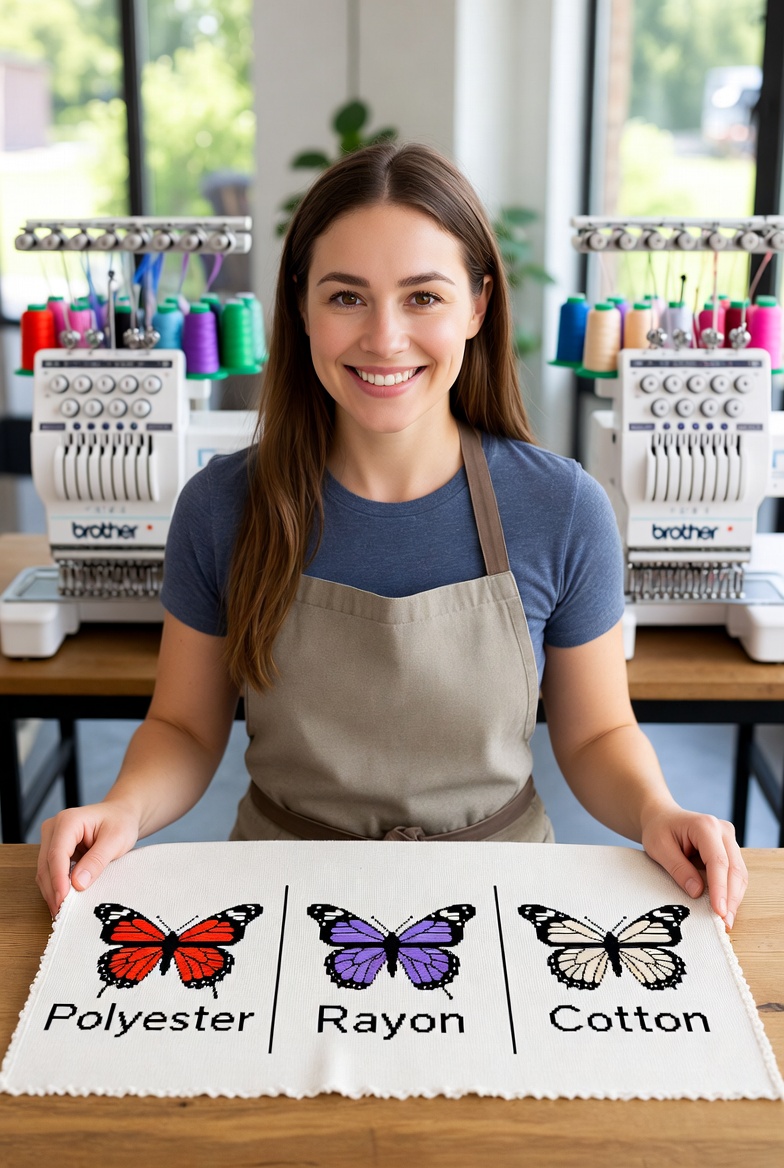
Polyester Thread: The Industry Standard
Polyester embroidery thread is the most widely used thread type in commercial and home embroidery, and for good reason. It offers the best overall balance of durability, colour retention, sheen, and value. Polyester thread is made from continuous filament polyester fibres, typically with a slight twist that provides strength without adding bulk. The resulting thread is strong, colourfast, resistant to fading from UV exposure and chlorine bleach, and capable of withstanding the high-temperature industrial laundering that commercial workwear and uniforms require.
The colour range available in polyester embroidery thread is vast — the Madeira Polyneon range, for example, offers over 400 solid colours plus metallics and variegated options. The colours are vibrant without being garish, and the slight sheen of polyester thread gives embroidered designs a professional, polished appearance that reads well at all sizes. Polyester thread holds its colour through hundreds of wash cycles, making it the only sensible choice for commercial workwear, uniforms, sportswear, and any item that will be laundered frequently.
From a machine performance perspective, polyester thread is the most forgiving option. It runs smoothly through tension discs and hook assemblies, produces minimal lint (reducing the frequency of machine cleaning), and tolerates minor tension variations without breaking. For beginners, polyester thread's forgiveness significantly reduces the frustration of thread breaks and tension-related quality issues during the learning curve. Polyester is the default thread type that StitchFast's Madeira colour matching references, ensuring that the colour suggestions in downloaded stitch files correspond to the most commonly available thread on the market.
Rayon Thread: The Aesthetic Choice
Rayon (also called viscose) embroidery thread is made from regenerated cellulose fibres — essentially wood pulp processed into a silky filament. Rayon's defining characteristic is its sheen: rayon thread has a higher lustre than polyester, producing embroidery that catches light with a rich, almost liquid shine. This visual quality makes rayon the preferred thread for decorative embroidery, fashion applications, and any project where the visual impact of the stitching is paramount.
The colour saturation of rayon thread is noticeably deeper than polyester. Reds are richer, blues are more intense, and the overall colour impression is more vivid. Rayon thread also drapes more naturally than polyester, producing satin stitch columns that lie flatter and smoother on the fabric surface. For these reasons, rayon is the traditional choice for high-end decorative embroidery, bridal embroidery, and applications where the embroidery is the focal point of the garment rather than a functional branding element.
The trade-offs are significant, however. Rayon thread is less durable than polyester — it is more prone to colour fading through UV exposure and repeated washing, less resistant to chlorine and industrial detergents, and more susceptible to abrasion. Rayon should not be used for workwear, uniforms, sportswear, or any item subjected to industrial laundering. It is also more temperamental on the machine — rayon thread is slightly less strong than polyester and more sensitive to tension variations, requiring more careful machine setup to avoid thread breaks.
The cost difference between rayon and polyester is modest — rayon is typically 10-20 percent more expensive per spool. For projects where the superior aesthetics of rayon justify the durability trade-off, the additional cost is negligible. The choice between rayon and polyester is not about quality — both are high-quality thread types. It is about matching the thread's characteristics to the project's requirements.
Cotton Thread: The Specialist Option
Cotton embroidery thread occupies a specialist niche. Made from natural cotton fibres, cotton thread produces a distinctly different appearance from synthetic alternatives — matte rather than shiny, soft rather than crisp, and with a handmade quality that is instantly recognisable. Cotton thread is the traditional choice for heirloom embroidery, quilting, cross-stitch-style machine embroidery, and any project where a vintage or artisanal aesthetic is desired.
Cotton thread's matte finish gives it a warmth and tactile quality that synthetics cannot replicate. On natural-fibre fabrics (cotton, linen, wool), cotton thread blends visually with the fabric surface in a way that synthetic threads do not, creating an integrated appearance where the embroidery looks like part of the fabric rather than sitting on top of it. This quality is prized in heirloom and heritage applications where the goal is quiet, understated craftsmanship rather than bold graphic impact.
The practical limitations of cotton thread are significant for commercial applications. Cotton is weaker than both polyester and rayon, requiring lower machine speeds and more frequent needle changes to avoid thread breaks. Cotton thread creates more lint than synthetic alternatives, necessitating more frequent machine cleaning. Colour options are more limited — cotton thread ranges typically offer 100-200 colours compared to polyester's 400+. And cotton thread shrinks when washed, which can distort embroidered designs on pre-washed garments. For these reasons, cotton thread is rarely used in commercial production embroidery and is primarily the domain of specialist hobbyists and artisan embroiderers.
Specialty Threads
Beyond the three main thread types, several specialty threads serve specific applications. Metallic thread incorporates a thin metallic foil film wrapped around a core thread, producing a sparkling, reflective appearance used for decorative accents, holiday designs, and premium branding elements. Metallic thread is the most difficult to run on an embroidery machine — it is stiff, prone to shredding, and requires specific needle types and reduced machine speeds. StitchFast's stitch files are compatible with metallic thread usage, though operators may need to reduce machine speed and increase needle size when stitching metallic sections.
Glow-in-the-dark thread (phosphorescent polyester) absorbs light and emits a green glow in darkness. It is used for novelty items, safety applications, and children's products. Fire-retardant thread (FR polyester) is mandatory for embroidery on flame-resistant workwear — standard polyester thread would melt and drip in a fire, creating a secondary burn hazard. Conductive thread incorporates metallic fibres that carry electrical current, used in wearable technology and smart textile applications.
Thread Weight and Its Impact
Embroidery thread weight (thickness) affects the visual density and coverage of the finished embroidery. The standard weight for machine embroidery is 40wt (weight 40) — this is what StitchFast's stitch files are calibrated for, and what the vast majority of commercial embroidery uses. Heavier threads (30wt) produce bolder, more prominent stitching with greater fabric coverage per stitch — useful for large designs on heavy fabrics. Lighter threads (60wt) produce finer, more delicate stitching — useful for small designs, fine detail, and lightweight fabrics where standard-weight thread would be too heavy.
Changing thread weight without adjusting the stitch file's density settings can produce unexpected results. A file digitized for 40wt thread will produce sparse, under-covered embroidery if run with 60wt thread (because the thinner thread does not cover the same width per stitch). Conversely, a file digitized for 40wt thread will produce overly dense, stiff embroidery if run with 30wt thread. If you plan to use non-standard thread weights, the stitch file's density should be adjusted accordingly — something that can be done in embroidery editing software after generating the base file through StitchFast.
Practical Recommendations
For the vast majority of embroidery projects — commercial workwear, personalised gifts, promotional merchandise, school uniforms, sports team wear, and general custom embroidery — polyester thread is the correct choice. It runs well on all machines, lasts through industrial laundering, maintains colour integrity, and is available in a comprehensive colour range. StitchFast's colour matching is calibrated for Madeira polyester thread, ensuring accurate colour suggestions in every downloaded file.
Use rayon thread for fashion embroidery, bridal work, decorative home textiles, and any project where superior sheen and colour depth justify the reduced durability. Use cotton thread for heirloom projects, quilting applications, and artisan work where the matte, natural aesthetic is central to the design intent. Use specialty threads only when their specific properties are required by the application.
Invest in quality thread. The difference between premium thread (Madeira, Isacord, Marathon) and bargain thread is measurable in stitch quality, colour accuracy, machine performance, and finished product durability. Premium thread costs perhaps 50 percent more per spool than bargain alternatives, but the per-garment cost difference is negligible — a few pence at most — while the quality difference is visible to every customer. In embroidery, as in most crafts, the materials matter. Choose them wisely.
Embroidery Thread FAQs
What is the best thread for machine embroidery?
Polyester is the best all-round choice for most embroidery. It runs well on all machines, survives industrial laundering, holds its colour, and comes in a wide colour range — which is why it is the industry standard for workwear, uniforms and general custom embroidery.
What is the difference between polyester and rayon embroidery thread?
Polyester is stronger and more colourfast, so it handles frequent washing and industrial use. Rayon has a higher sheen and richer colour depth, making it the aesthetic choice for fashion, bridal and decorative work where appearance matters more than durability.
When should I use cotton embroidery thread?
Cotton thread suits heirloom projects, quilting and artisan work where a matte, natural finish is central to the design. It is a specialist option rather than an everyday choice, since it is less durable and less colourfast than polyester.
What thread weight should I use for embroidery?
40 weight is the standard for most machine embroidery and works for the majority of designs. Finer 60 weight is used for small lettering and fine detail, while heavier 30 weight gives a bolder, more textured look.
Is premium embroidery thread worth the extra cost?
Yes. Premium brands like Madeira, Isacord and Marathon cost around 50 percent more per spool, but the per-garment difference is only a few pence while the gain in stitch quality, colour accuracy, machine performance and durability is visible to every customer.